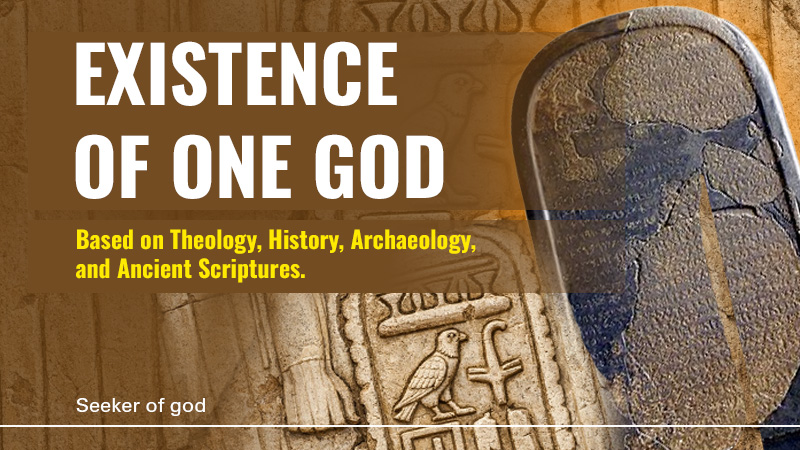
Based on Theology, History, Archaeology, and Ancient Scriptures.
Abstract
This document presents a conclusion derived from the study of theology, historical records, archaeological discoveries, and ancient scriptural texts. The purpose of this study is to objectively examine whether the concept of one true, eternal God is supported by evidence rather than personal belief, cultural influence, or emotional reasoning. The findings indicate that the existence of one eternal, self-existent God is the most consistent and logical conclusion supported by theological definition, historical continuity, archaeological evidence, and scriptural preservation.
1. Theological Analysis
Theological reasoning seeks to understand the nature and attributes of the ultimate cause of existence.
Logical theological analysis concludes that the true God must possess the following attributes:
- Eternal (without beginning or end)
- Uncreated (not caused by any other entity)
- Self-existent (independent of all creation)
- Singular (only one ultimate source, not multiple competing sources)
- The creator and sustainer of all existence
A being with these attributes is described in theology as the “necessary being”-the one whose existence is required for anything else to exist.
Ancient Hebrew theology uniquely identifies God with these attributes, especially in the declaration “I AM
2. Historical Evidence
Historical analysis confirms that belief in one supreme God existed in ancient Israel more than 3,000 years ago.
The Hebrew scriptures consistently declare that there is only one true God.
Key historical declarations include:
- “Hear, O Israel: The Lord our God, the Lord is One.” (Deuteronomy 6:4)
- “I am the Lord, and there is no other.” (Isaiah 45:5)
These statements represent one of the earliest and clearest forms of monotheism in recorded human history.
The continuity of this belief has been preserved through generations, confirming that it was not a later philosophical invention, but an established ancient theological position.
3. Archaeological Evidence
Archaeological discoveries provide independent physical confirmation of the historical worship of one God identified in ancient Hebrew tradition.
Significant archaeological findings include:
- Egyptian inscriptions referencing “YHWH” dating to approximately 1400-1200 BC
- Ancient Hebrew inscriptions mentioning the divine name
- The Dead Sea Scrolls confirming the preservation and accuracy of ancient Hebrew scriptures
These discoveries confirm that the belief in one eternal God was historically real and documented.
4. Scriptural Consistency and Preservation
Ancient Hebrew scriptures demonstrate exceptional preservation, internal consistency, and theological depth. These texts describe God not as part of nature, but as the creator of nature and existence itself.
The description of God as eternal, self-existent, and singular is philosophically consistent and aligns with logical necessity.
The preservation of these texts over thousands of years strengthens their reliability as historical theological sources.
5. Logical and Scholarly Conclusion
Based on the combined evidence from:
- Theology (logical necessity of one eternal, self-existent being)
- History (continuous belief in one God)
- Archaeology (physical inscriptions and discoveries)
- Scriptures (consistent and preserved ancient texts)
The most reasonable and evidence-based conclusion is that there exists one eternal, uncreated, self-existent God who is the source and cause of all existence.
This conclusion is not based on personal opinion, cultural tradition, or emotional influence, but on objective analysis of theological definition, historical documentation, archaeological discovery, and scriptural consistency.
Well